Ever since he appeared fresh from the Birmingham Conservatoire with a self-produced EP and loads of potential some 25 years ago Jim Moray has been constantly bending, twisting, reinventing traditional music into various contemporary forms. His albums have been ground breaking from the astonishing electro debut ‘Sweet England’ to the experimentation of ‘Low Culture’ each stacked with delights and surprises. Now after a period of reassessment and contemplation comes ‘Gallants’ which raises many questions, including just what is a Gallant anyway? Simon Jones listens intently whilst taking notes.
If the definition of a good interview is that the artist knows a lot about their music, where it comes from and what processes it’s been put through to get the desired result then Jim Moray is up there with the best. To say he’s well informed is perhaps an under-statement, his research is deep and complete, his answers to questions not only expansive but considered, points are well made. You get the feeling that he likes seeing which way a conversation about his music will develop and is open to the swerves and changes that are naturally inherent.
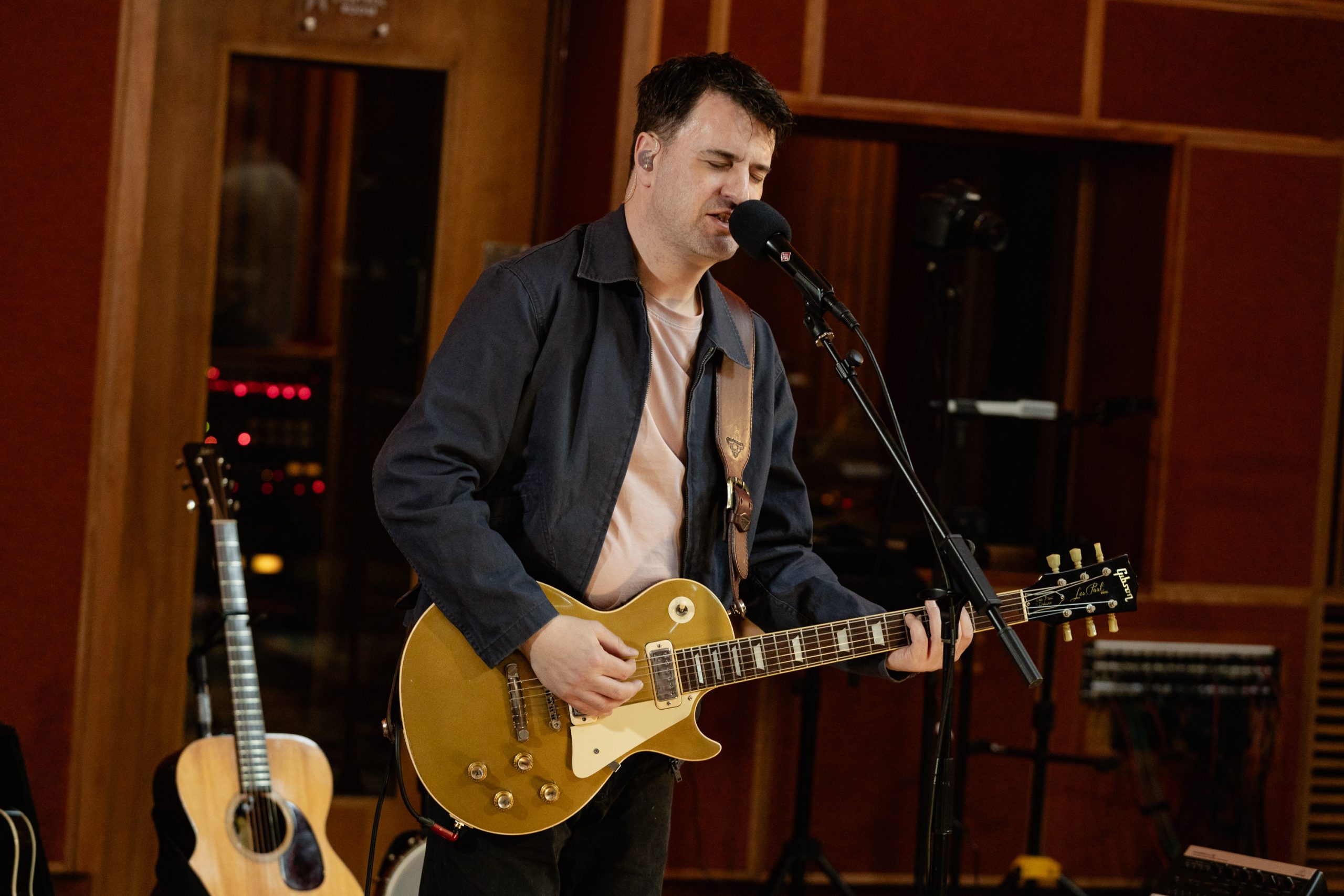
When I ring him late on an April Monday afternoon, he’s just about to have a cup of tea having already done another interview but insists he’ll get it later…which turns out to be almost an hour. Sorry about that Jim but there’s such a lot to discuss. Like the cracking concert you gave at Shrewsbury Festival 2025 which was a nigh on perfect example of how traditional music can be melded to modernist rock. Even better there wasn’t a fiddle, squeezebox or other folk instrument in sight, it was a four- piece rock band. One of those moments that if you missed it then you missed out on the justification for and fulfilment of recognisable endemic rock.
“That’s good to hear. I wasn’t really sure how the set was going to go down as we were up against Skerryvore over on the other stage. We left straight after so got home early morning. It felt fine up there just drums, bass, keyboards and guitar/vocals but there wasn’t much time to get feedback. I’m glad that it came over well.”
You got plenty of calls for an encore, even during the show people were shouting out for songs they loved.
“Yes, I wouldn’t call it a greatest hits set but I’d say it had most of my best known songs.”
Beginning with ‘Fair Margaret & Sweet William’ that show zipped along visiting amongst many ‘Rufford Park Poachers,’ ‘Leaving Australia,’ his own ‘Sounds Of Earth,’ ‘Sweet England,’ ‘Polly On The Shore,’ ‘Spencer The Rover,’ ‘Edward Of The Lowlands,’ ‘Seven Long Years’ all killer, no filler. Then there was the fitting nod to Dick Gaughan with “a song I used to hear in the car” ‘Jock O’Hazeldean.’ Put it on the next album please.
You’ve a group of musicians who’re really in sync with what you’re doing.
“I’m onto something with my band at the moment I can feel it, so I hope I can hang on to them. The core of the group is Stuart Provan on drums and JJ Stoney with keyboards, though we’ve just added another guitarist and I use a couple of trusted bass players. They’re all people who I can work with and I enjoy playing with too. Having a band which can reproduce my music so well is important and they drive me to achieve. I hope to be able to persuade festivals and larger venues of our potential.”
Festivals must be stone deaf and have cauliflowers for ears not to appreciate the music’s value and potency if you ask me. Give the people what they need as well as what they want. In this case Jim. It’s been seven years, 2019 to be precise, since we got a new album’s worth of material from JM and as we speak ‘Gallants’ sits ready for issue. It’s somewhat mysterious, the cover even more so. What exactly is a Gallant in your thinking?
“Obviously there’s the bravery aspect and that a knight or young soldier could be referred to as a Gallant, but in the context I’m using it then the meaning doesn’t really apply. It’s still a noun but with my song ‘Three Gallants’ the idea is more like the lyric in ‘Crazy Man Michael’ or Lal Waterson’s ‘Scarecrow.’ They’re mythic, dark figures with more than a touch of surrealism. If you were to ask me what are they like physically I’d have to say whilst they have no clear meaning and in my song they’re ephemeral, the figure on the album cover is wearing my idea of a Gallant’s costume.”
The front of the ‘Gallants’ shows a somewhat spooky image with guitar and clothing which on first glance appears to be a melange of ritual costume influences, added in more than a hint of ‘The Wicker Man.’
“There are some traditional elements and then others I thought of,” he confirms, “the body part of the outfit comes from the Whittlesea Straw Bear custom which takes place each January, the mask has hints of Japanese Oni theatre but really is based on the one used in The Hunting Of The Earl Of Rone festival which happens in Spring at Combe Martin, Devon. The more modern touches are obviously the fact I’m wearing jeans and trainers and have an electric guitar over my shoulder. That’s a nod to the cover of ‘Morris On’ where if I recall Ashley Hutchings is dressed as a Morris dancer holding a Gibson Flying V.”
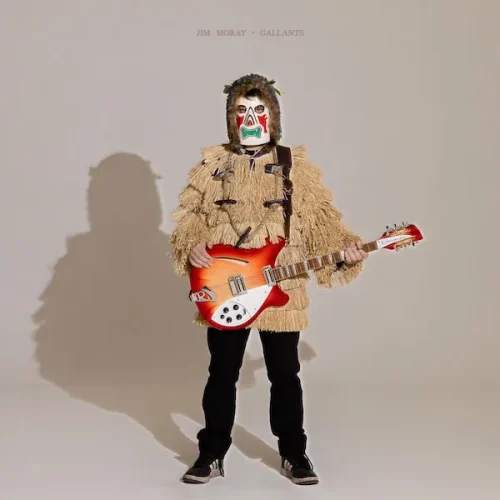 Gallant with Rickenbacker and trainers!
All of which just goes to show that there’s more at work here than just reviving old folk material, careful consideration even stretches to the subtler parts of album photography. But back to the songs…. ‘Flora The Lily Of The West.’
“I’ve known that song for a long time. There are lots of variations, Steve Knightley sings one from the southwest of England but for mine Steve Turner was probably the biggest influence. It seemed like the song had been waiting to be tackled and as luck would have it a student said to me that whilst we’d been studying folk songs there seemed to be few decent men in the tradition. (It should be explained at this juncture that Mr. Moray has a teaching commitment at Leeds Conservatoire.) I went away and thought about what she’d said and whilst ‘Flora’ doesn’t have a good guy it does take a while to realise that the character at the centre of the song believes he’s done the right thing and even though he’s going to be hung for his crime, he still harbours feelings for Flora herself and in some ways can’t see what he’s done wrong. In that respect I suppose he’s an anti-hero, who you can sympathise with. The song is basically about a crime of passion.”
Never afraid of experimenting with other genres, who can forget the folk rap of ‘Lucy Wan’ on ‘Low Culture?’ With ‘Gallants’ Jim’s embraced the new jazz emerging from his old stomping ground of Bristol. They’re particularly noticeable on ‘When I Was A Little Boy.’
“That was deliberate and I wanted to see how what I do might fit in with some of those amazing west country musicians. I reached a bit beyond my experience there. The lyrics to that song are obviously nonsense and boasting but at the same time they’re surreal. There’s just something about the freedom that jazz implies that fits with surrealism. The brass players are used to extemporisation and basically wandering off proven pathways yet they give so much energy to what they do.”
We then get diverted about the successful use of surrealism in music and even film which Jim brings to a fitting conclusion with “Surrealism is a privilege in itself.” Enough said.
So Jim ‘Omie Wise’ a very moody and very long track.
“I knew that from the ‘Harry Smith Anthology Of American Folk Music,’ (where it’s performed in a 1927 recording by G.B. Grayson and Henry Whitter,) it’s probably the longest thing I’ve ever done, or was ‘Lord Douglas’ about the same? Anyway when the Anthology was updated the McGarrigle sisters did a version and Elvis Costello wrote an answer song. I’ve kept the atmosphere hopefully by doing it in a sparse setting. David Le Page who played strings on the track helped me a lot with that. Overall though, less is more applies.”
You can see that track working on more than one level though because it is based on an actual murder from the early 1880s.
“The finished version of the song is a mix of the original narrative and my personal opinion. The true facts are lost in the ballad so I added some lines to reiterate the reality.”
Had he heard the equally startling and electronic doom version by Snakefarm?
“No I’ve not but now that you mention it that’s one to look into.”
‘Spencer The Rover’ is perhaps the most well-known track on the album, another with history, The Dransfields who taught it to John Martyn.
“‘Spencer’ had been hanging around for years, I played it way back. Originally it was scheduled to go on the follow up album to ‘Sweet England’ but there was just something which meant it wasn’t the right time to issue it. Now twenty odd years later and my eldest child is growing I felt old enough and able to relate to the song so I could sing it. The jazz and brass players really gave the track weight adding power to the delivery. It was fun working with cornets, trombones and various horns, their sound is a different kind of English music.”
‘Train On The Island’ is another from America.
“Really it’s an old time fiddle tune. Loads of different variations and lots of performers each one with a divergence of interpretation. The fact that my take is slowed right down, makes the vocals more central, it’s less of a dance tune so the lyrics have clarity. Bruce Molsky has a video on YouTube which gives you an idea of how it’s performed over in the USA. I wanted to highlight the words which relate to frailty, the way life can take unexpected turns which lead to difficulties, mental health problems.”
One listen to the song on ‘Gallants’ backs up totally everything Jim says, ‘Train On The Island’ is as much more a cry for help than record of a relationship which fails. Taken at an unhurried tempo rather than a flat out sprint, the train runs out of steam and energy as the lyric echoes fading health “sometimes I say too much, say nothing at all.” The song is buoyed lightly on piano, electric guitar and synths creating an atmosphere of melancholy, hopelessness and finality. All in all, a powerful item.
So there’s more than the music behind your albums, maybe hidden messages and thoughts?
“There is a kind of sub theme yes, I wanted to make a record that covered all aspects and facets of what it means to be a man in the 2020s. There is so much that gets overlooked and it’s a complex subject really.”
‘Gallants’ – if you listen carefully and think a little deeper has within the songs different characters and actions, some good, some downright atrocious, some muddling through, some in control, some out of control, some seeking redemption, those who want a new beginning, others pondering what might have been. All life as they say is in there.
A bit like Jim actually because in 2026 he’s not just a musician, he’s a producer, serial collaborator and as mentioned before an academic. As our conversation is winding down I ask him how his role in education helps inform his musical activities.
“Teaching brings clarity in other things I do,” he says after a long pause for thought, “it helps me very much with how I approach my work. Very often in the courses I teach students have a more straightforward view of things and don’t clutter up their thinking.”
Are they aware of your musical reputation?
“No, I don’t think many of them are. I’ve reached that age now when I’ve been around for more than two decades so today’s students coming through were more than likely born after 2010 and they won’t know what folk music was like before then. So for all my work I’m not as well known by the present generation.”
Which leads us to another diversion, the health of the folk scene in the late 2020s; somewhat diffuse but still with bags of potential we conclude. I relate that it seems to me the Scots find it far easier to progress their traditional music than the English which Jim counters by mentioning Frankie Archer who is “taking what I began but is shaping in her own way. I’m excited by what she is doing with folk sources and how she is doing it. I suppose I have always been fascinated by and still am, even in my academic role, the way that traditional music can intersect with modern pop and dance.” The names he offers includes London’s venerable folkpolymath organisation – band, label, club and concert promoters Broadside Hacks, whilst I bring up Manchester’s free-wheeling, rough but glorious Brown Wimpenny.
I could have left matters there but I have to ask about the closing track on ‘Gallants’ an absolutely stunning piece of close harmony ‘Fortune Turns The Wheel.’ It reminded me of Brain Wilson’s autumnal, almost medieval chorals on the Beach Boys final ‘That’s Why God Made The Radio.’
“There is that aspect you’re right, but ‘Fortune’ is really the English answer to the Irish ‘The Parting Glass.’ A farewell to those who are being left behind and a looking forward to what will come. I tend to think it’s the pinnacle of a song constructed over generations that will never lose its function. The lyrics are so relevant as well, timeless. It was always going to be acapella, I put together my own quartet which included Maddie Morris for the harmonies, I couldn’t find a choir which had the right sound, but I’m very pleased with the way the track turned out.”
I glance at my watch and nigh on an hour has flown by since we began. I thank Jim for his time and patience, he returns with thanks for the interview and I put the phone down. A cup of tea well earned, I hope he had a brew right away. ‘Gallants’ should be in the collection of any sane music lover and will no doubt be in many Best Of lists as 2026 comes to a close. In fact to see him live you’ll have to wait until early 2027- his website has dates and venues – but there is online, a brilliant live session with the band wherein the whole album is played from The Arch in Southport, plus you might have caught the same ensemble doing a couple of songs for Radio 4’s Loose Ends, check I player for that. Oh, and the dazzling set from Shrewsbury 2025 is on the web as well. Jim Moray is everywhere. Long may that continue.
There are not many who can say they’ve redefined a musical genre but he can. What’s more he continues to do so. Quite remarkable.
Photography Robin Clewley.
www.jimmoray.co.uk